Materials · Guide
Thermally modified wood, pressure-treated or composite?
Decking materials compared — durability, maintenance, price and appearance in Finnish conditions, plus tips on installation and board spacing.
Reading time ~6 min · Updated 8/2026
The decking material determines how your terrace looks, how much maintenance it needs and how long it lasts. In Finnish conditions — moisture, frost, the sun's UV radiation and snow — a durable choice saves money in the long run. Here we compare the four most common options: pressure-treated pine, thermally modified wood, larch and composite.
Terrace material comparison
| Material | Price (€/m²) | Service life | Maintenance | Appearance |
|---|---|---|---|---|
| Pressure-treated pine | approx. 200 | 15–25 yrs | Oiling every 1–2 yrs | Greenish, ages to gray |
| Thermally modified wood | approx. 300 | 25–30 yrs | Oiling, moves little | Brown, ages evenly |
| Larch | approx. 250–320 | 20–30 yrs | Oiling | Red-brown, ages to gray |
| Composite | approx. 370 | 25–30+ yrs | Washing only, no oiling | Even, permanent color |
Pressure-treated pine
The most affordable and most common decking material. It withstands ground contact and moisture, so it also suits use close to the ground. It needs regular oiling to stay tidy, and it moves — meaning it can warp and crack slightly. A good choice when budget is the priority.
Thermally modified wood
Heat treatment makes the wood water-repellent and dimensionally stable — it moves clearly less than treated pine and ages to a beautifully even gray. Its darker, warm tone is popular. More expensive than treated pine, but the longer service life and tidier result make it a popular quality choice.
Larch
A naturally durable softwood with a beautiful red-brown tone and striking grain. It withstands changing weather well without treatment. A good fit when you want the look of natural wood with good durability.
Composite
A blend of wood fiber and plastic that needs no oiling or sanding — washing is enough. The color stays even year after year, and no splinters form on the surface. The most expensive to buy, but near maintenance-free and long-lasting. An excellent choice if you don't want yearly maintenance. See composite terraces in our services.
Which one should you choose?
- Budget first: pressure-treated pine
- Maintenance-free: composite
- Quality and looks: thermally modified wood
- Natural-wood look with good durability: larch
- Waterfront and damp locations: thermally modified wood or composite
Installation and board spacing
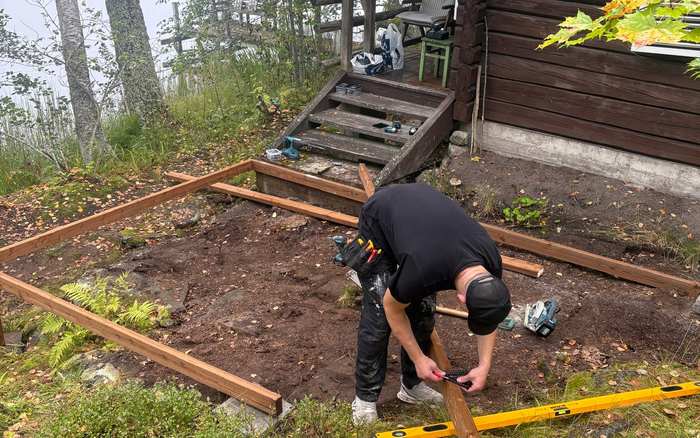
A durable result comes from correct installation:
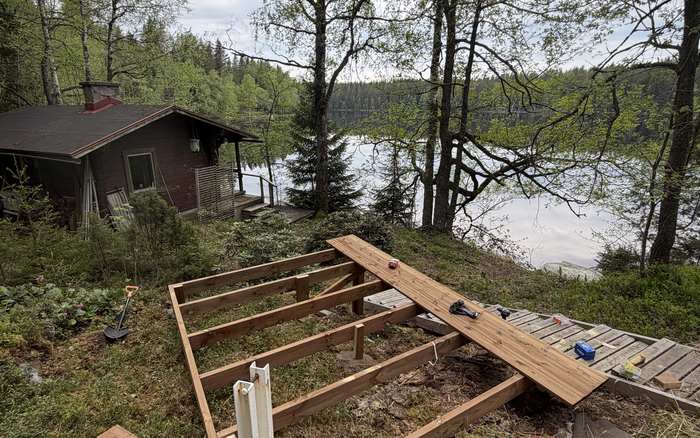
- Joist spacing (the distance between the frame timbers) is typically about 600 mm for wooden decking and tighter for composite, about 300–400 mm, because composite flexes more.
- Board spacing — the gap between the boards — is left for water to drain, typically a few millimeters.
- Always use stainless or acid-proof fasteners — galvanized ones rust and darken the wood.
- Make sure the frame is ventilated so moisture can escape.
- A terrace built more than 50 cm above the ground needs a railing for safety.
Maintenance
A wooden terrace is washed in spring and oiled as needed every 1–2 years — the oil protects against UV and moisture. Composite just needs washing; it needs no oil. We also do terrace maintenance and washing if an old terrace needs freshening up.